FIELD NOTES / 02 · 6 minute read
Watch sizes & straps
Four useful measurements. Understand what actually changes the fit.
Millimetres help you compare watches, but they are not a dress code. Wrist shape, case curvature and the way a strap leaves the lugs matter as much as the headline diameter.
Use a watch you already enjoy as your reference point. Measure it, then compare the watch you are considering against it.
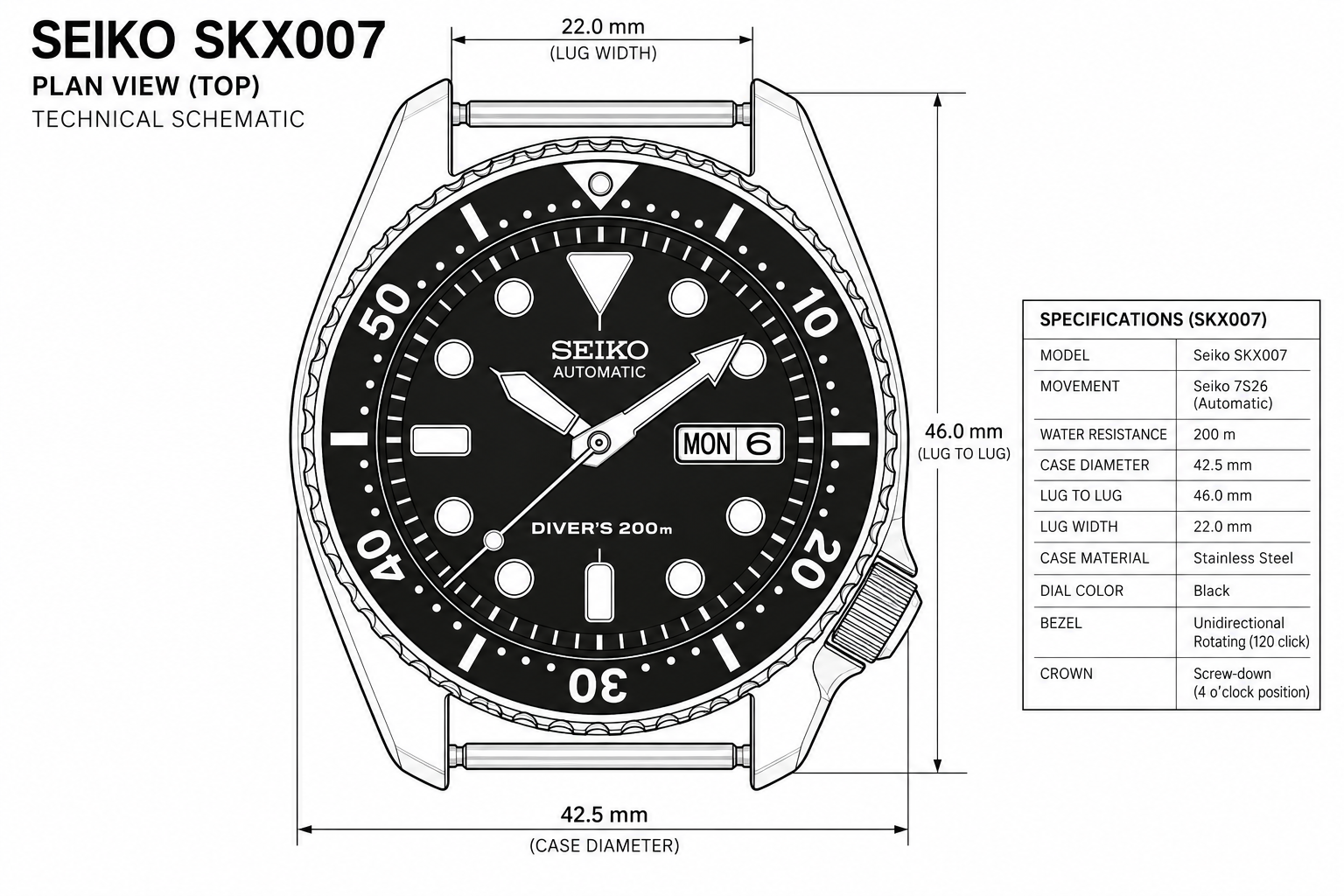
The four measurements.
 View drawing full size ↗
Case diameter
The width across the main case, normally excluding the crown. A broad bezel leaves less visible dial than a narrow bezel on a similarly sized watch. A clean dress dial can therefore look larger than expected, while a diver’s bezel breaks up the same space.
Lug-to-lug length
The distance from the outer tip of the top lugs to the outer tip of the bottom lugs. This is a useful starting point for judging whether the watch sits within the top of your wrist. Rigid bracelet end links can extend the effective span beyond the bare case measurement.
Lug width
The gap between the inside faces of the two lugs, where the strap attaches. It is not the width across both lugs. Match the strap’s attachment width to this gap: a loose narrow strap or a forced wide one is not a good substitute for the correct fit.
Thickness
The height from the underside of the case back to the top of the crystal. A tall watch can catch a cuff or feel top-heavy. A curved case back and sloping lugs can change how that height feels; an under-watch fabric strap adds its own layers.
THE TUNA / THE POINT IN PRACTICE
A big diameter.
A shorter reach.
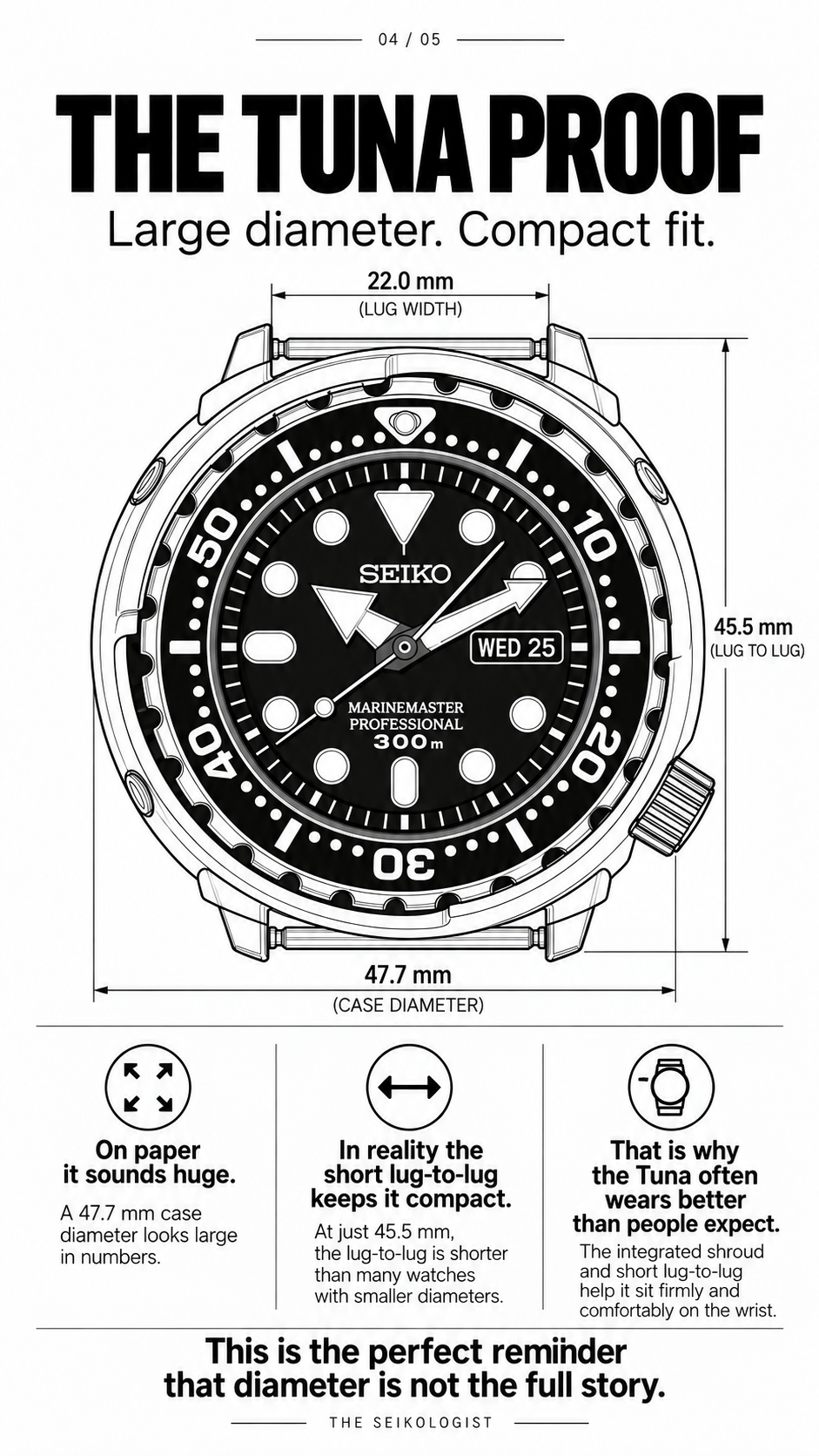
The Tuna is the clearest reminder to look beyond the headline diameter. Its broad protective shroud gives it a substantial presence, but its short lugs keep the strap attachment close to the case.
Instead of long lugs reaching out across your wrist, the strap can turn down relatively close to the watch. That is why this wide, round design can be more wearable than its diameter first suggests.
Compact lugs do not make a small watch.
The shroud still occupies space. Thickness, weight, wrist shape and the stiffness of the strap all matter. Compare the complete outline on your wrist, as well as where the strap starts to bend.
Reading this drawing: the marked lug-tip span is distinct from the overall shrouded case length. Do not treat it as the watch’s complete footprint or assume every Tuna reference shares these dimensions.
 View drawing full size ↗
SAME QUESTIONS / DIFFERENT SHAPES
From Turtle to Speedtimer.
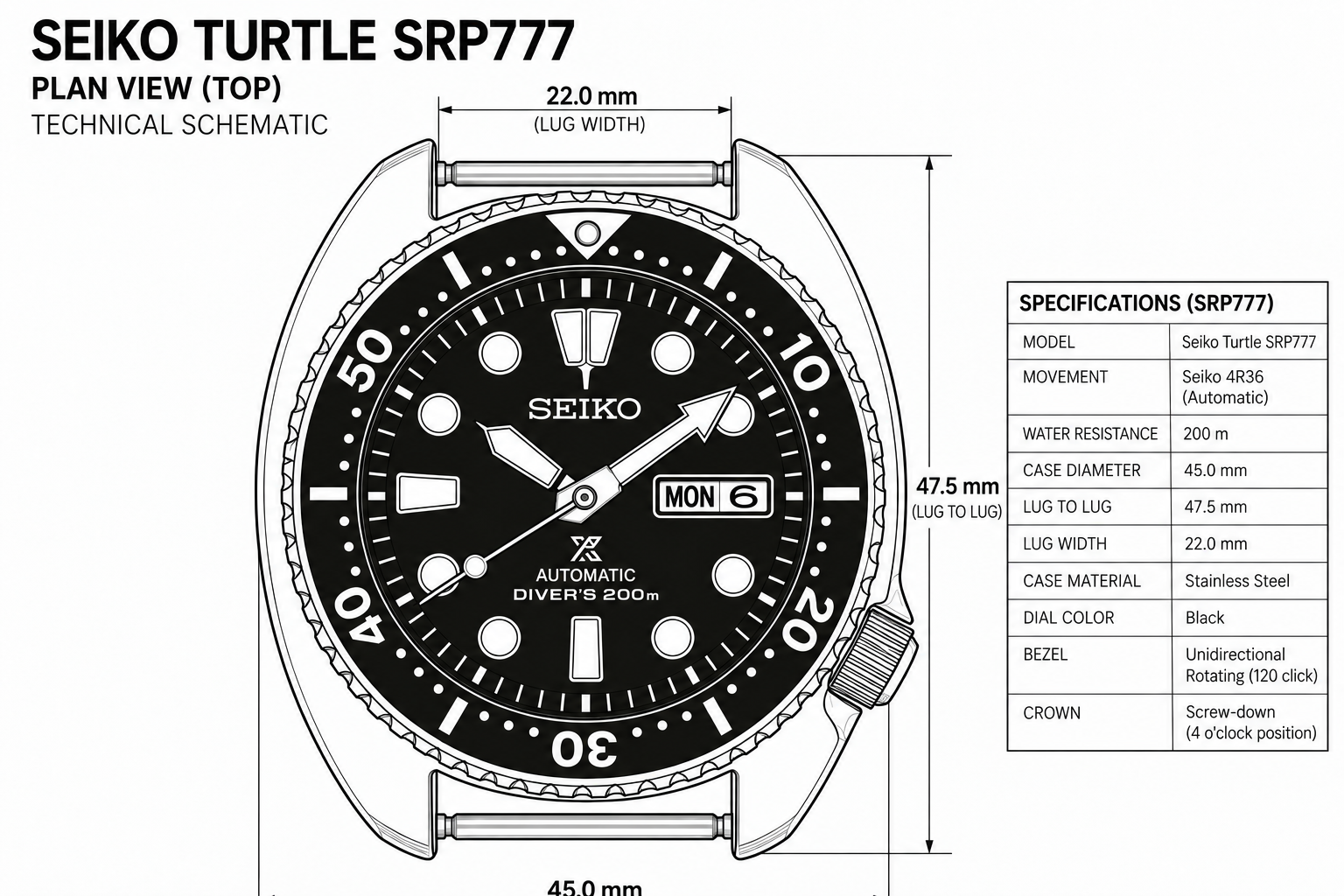
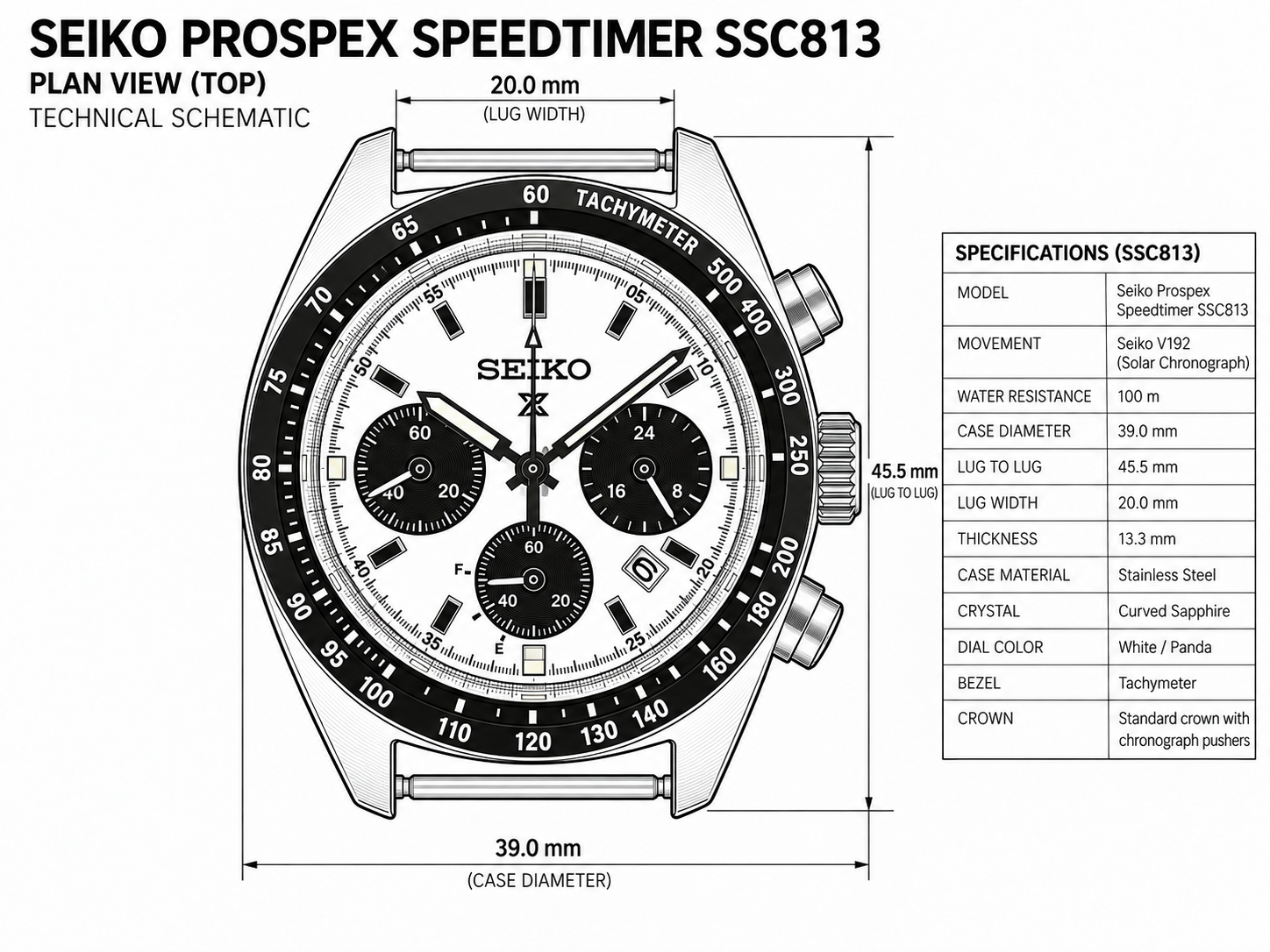
The Turtle’s cushion case and the Speedtimer’s more compact chronograph case have very different characters. Follow the vertical measurement to understand their reach, then check the horizontal strap gap before choosing a strap.
Turtle SRP777
 View drawing full size ↗
Speedtimer SSC813
 View drawing full size ↗
These are illustrations supplied by The Seikologist, displayed at different scales. Compare the measurements, not the size of the drawings on your screen. SSC813 manufacturer specifications.
A smaller diameter can still mean a longer watch.
The smaller-diameter watch below is actually the longer one. Look across the row, not just at the first number.
| Reference | Diameter | Lug-to-lug | Thickness | Lug width |
|---|---|---|---|---|
| SRPG35 · field | 39.4 | 48.1 | 13.2 | 20 |
| SSK003 · GMT | 42.5 | 46.0 | 13.6 | 22 |
Measure your wrist, then look at its shape.
Use a soft tape around the part of your wrist where you wear a watch, snug without pulling tight. If you use paper, mark the overlap and measure it flat. Circumference helps with strap length; it does not reveal how flat or rounded the top of your wrist is.
When trying a watch, look in a mirror with your arm relaxed as well as straight down at it. Close phone photographs can exaggerate the watch’s size. Move your wrist, bend your hand and try a cuff over it. Comfort is a better guide than a rigid rule linking wrist circumference to case diameter.
The strap can change the watch.
Leather
Can soften a sporty watch or complement a dress dial. Check length, thickness at the lugs and buckle position. Keep ordinary leather away from soaking; a watch’s water rating does not make its strap waterproof.
Rubber & fabric
Rubber suits many divers, but stiffness varies. Fabric can make a watch feel more casual; pass-through designs add height underneath the case. Check that material and spring bars fit without being forced.
Bracelet
Check the maximum fitted length, spare links and clasp adjustment. End links must match the case: two Seikos with the same lug width do not necessarily accept the same fitted bracelet.
Strap taper means the strap becomes narrower towards the buckle. It can make a watch look lighter on the wrist, but buckle width is a separate measurement from lug width. Seiko spring-bar dimensions and end-link shapes also vary; width alone does not guarantee compatibility.
KEEP EXPLORING
Choosing your Seiko →Buying a pre-owned Seiko →Join the drop list →